
As we progress through this journey, we arrive at the beginning of my journey to becoming a Biomedical Scientist (BMS). When we last left off, I had realised where I was really meant to be. On a different side of healthcare. Somewhere that I could apply a much more scientific approach to, but all the while maintaining a presence in the journey of my patients. Biomedical sciences was the role for me, so I applied to the course during my working year out and thankfully was accepted to the programme. But what goes on during the initial years of the course? and how does a BMS come to bridge the gap of science and medicine?
(Quick link before I start. The list of modules I undertook in each of the two years discussed here are at the very bottom of the post. I couldn’t write them in without discussing them all so I’ve formatted this way for ease.)
Initial Thoughts
The beginning of any university course can be a daunting experience for anyone. I left this out of my prior post because I feel its much more suited to this one. This time around I knew this was what I truly wanted to do. I’d been exposed to the healthcare environment and seen the numerous roles available and I was by this stage 100% certain in my choice.
Regardless of if you’re a top level student maintaining an A* average or someone cramming in hours of work daily to scrape a pass; there are a number of questions that creep up into the mind of a university student prior to commencing their course. “Am I really smart enough to be here?” is possibly the most common question I know that my peers ask themselves. Even though I’d already been through a year of university and finished that year with a first, i wasn’t sure if I was as capable as I imagined I was when I applied. This was a different course. Much more scientific and academic and the sorts of tasks I was going to be expected to carry out were very different from anything I had done before. Regardless of where you come from or your background. It’s only natural to have these thoughts. But the adage stands true, you miss 100% of the shots you don’t take. You can’t let fear rule your decision making process. You have to go for it and make mistakes and learn from them. Draw on your experiences and push yourself.
It isn’t that you don’t ask yourself these questions when you first apply to university. You do. I think it’s just that when you’re accepted and ready to go and the onus is on you now. You see these questions in a brand new light. And you have to answer them in the context of this new vantage point.
Once I got myself up and over the wall that was built with bricks of shock, uncertainty and doubt, I sorted my accommodation and everything I needed to get started. At this stage I would also like to point out that I was able to channel my inner stationary nerd. I’m certain beyond a shadow of a doubt that the ensuing stationary shopping that took place for this course, was one of the better nerd based moments of my life. There was a lot of colour involved, many notebooks, such highlighters, much wow. Far too much money was spent that day and I don’t have any guilt or regrets. Anyway, enough of my deplorable greed.
Finally, We Begin
So here we are. I’ve embarked on the first of my academic years at university. So what did I do? The first year for most university courses, is an introduction to university life and a gradual progression to bring you up to speed with the standards required and the amount of work that you’ll be undertaking. For me, this meant a good portion of the first was what I’ve categorised as “the general science year”. For the majority of this year we spent time focusing on the principal skills required of a scientist during our practical classes and then the overarching theoretical knowledge and central dogmas of our relevant sciences. Specifically learning the functions of the human body. The nitty gritty of how it works normally. These modules were our underpinnings and foundations and they were relevant to a large portion of science students; so we shared a lot of these modules with other science based degree students. Optometrists, dietitians, nutritionists and biologists for example.
Each course had their own practical/theory split but for biomedical sciences it was 50/50. For every hour spent learning theory, there was hour spent applying that knowledge in practical context. Cardiovascular system lecture, followed by applying electrical current to the vagus nerve of a frog and assessing the effects on the heart rate. A lecture on amino acids, their structures and functions, followed by chromatographic separation of amino acids from solution. And yes, this meant an extremely absurd amount of titrations. If you know, you know.
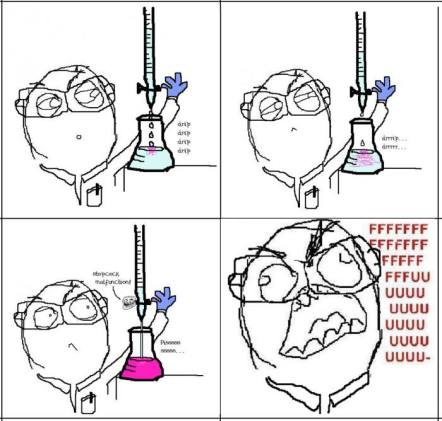
Most of these practicals were in the region of three or four hours. Of course there was the theoretical knowledge which you had to try and apply to what you were asked to do. You had to prepare your experiment and then carry it out. There were graphs to be drawn and calculations to be made to support your hypotheses and then there were supporting questions designed to consolidate knowledge at the end of the practical session. Not a short process by any means.
It is here that I bring back a point I made in a previous post about BTEC students seeming better prepared for this way of life than the A-level students. For the BTEC students I knew, this was the way things had been going already. There is no exam assessment in a BTEC, but there was an exceptional amount of work to be done. There was coursework being handed in and more being assigned each and every day. With the exception of coming up to holidays. The way a BTEC is assessed is that you must pass the assignments for each module up to the level you wish to aim for. So lets say for one full module there is four topics. Each of these topics may have an assignment. So in order to get the highest grade of distinction you must do the pass level assignment, the merit level assignment and finally the distinction level assignment. That’s four topics with three assignments each (if you go for a distinction. It would two assignments each or one assignment each if you went for a merit or pass respectively). So to achieve a distinction in that module you had to hand in twelve assignments. You have ten modules per year to undertake so if you do your maths, you’ll see that comes out at 120 assignments per year give or take as some modules may have more or less topics included. So you’ll see why BTEC students are no strangers to hard work.
Second Year
Moving onto second year then. Second year is what’s referred to as a discipline specific year. I’ve also heard it being called the “applied year” or the “Pre-clinical year”. Its where you undertake all of the modules relevant to the work a BMS undertakes. So functional learning is really the key in this year. All of the modules were human biology specific and were related to abnormal functioning of the human body in a diseased state. “Pathology” as we call it. This is the progression from first to second year. Like I’ve mentioned, first year is all about learning what happens normally in the body, and in second year you progress to learn about what happens when it all goes wrong!
I think if you were to ask those around me on my course, there would be a resounding and uniform voice of agreement when I make my next statement; The jump from first year to second year, academically speaking, could be considered a form of torture. In fact if it was assessed by defence professionals, I’m sure it would breach the Geneva convention.

Second year was an extremely tough year and everyone I’ve spoken to agrees with this. It’s as if the university decided that we hadn’t left in first year so they could remove our protective packaging and throw us around a little more. Coursework was coming out of the word work, class tests became a bi-weekly occurrence and the depth of the content left the majority of people in a state of disbelief. People’s averages started dropping quite quickly at the beginning of the year and it wasn’t long before people began to realise that this was not going to be a walk in the park.
I would say the amount of time spent studying increased dramatically. In first year it was possible to get away with a like for like study time. What I mean by that, is if you had an hours lecture you could get away with putting in an hour at home to consolidate your learning. With a second year lecture, if it was an hour in length. Then around two hours was needed at home. You left the lecture for the most having a basic understanding of what you’d listened to but when you got home you had to spend the first hour reading around the topic and figuring the material out. Then you could get around to finally solidifying that knowledge in the next hours worth of studying.
Thankfully, once people started to realise this and knuckled down to their work and enhanced and upgraded their study routines, it all fell back into place. I think that initial shock was enough to scare a lot of people into applying themselves to what they needed. The practical/theory split for second year changed only very slightly to 40/60 in my opinion. There was an awful lot of theory needed this year in order to prepare us for going into a hospital environment. Let’s not beat around the bush, we were going into an environment where (student or not) people would be questioning us on this knowledge and expecting us to know the answers.
Throughout this year, aside from the academic modules, we were also expected to be doing placement preparations. This meant we had to attend lectures on a Tuesday morning which were discipline specific. So if the mornings lecture was on haematology, then we would have a professional haematologist come in and talk to us about what goes on in the lab and what they do. Following this we would have a student who had finished a haematology placement deliver us a lecture on their experiences and give us some case studies from their time on placement (This could be me giving this lecture this year, scary!). As well as this we had to attend laboratory tours of some of our pathology laboratories from each of the Trusts. We then had to select which laboratory we wished to conduct our placement in picking our top three choices. Places were then determined by our exams. We were all ranked in order from our exam marks and this determined whether or not you got your top pick, second or third. Thankfully I managed to secure my top pick!
So I finished my second year and if I’m honest, at the time I was glad it was over. In case you can’t tell I love science. I’m absolutely obsessed with it. But everybody needs a break and I’d taken a beating that year. It was only a few weeks into my summer break that I was dying of boredom and started revising again to prepare for my placement, but i needed that break. Looking back now, I really thoroughly enjoyed the content in second year. It was a fantastic year and I learned a lot of valuable information. Even if I did tear half of my hair out trying to remember it all!
List of Modules-
Year 1:
Anatomy and Physiology
Chemistry in Practice
Biostatistics
Biochemistry
Bioanalytical Chemistry
Medical Cell Biology
Year 2:
Immunology
Microbiology
Pathophysiology
Applied Genetics
Haematology
Clinical Biochemistry
Cellular Pathology
Professional Practice (basically this was just placement preparation.)
 Blood Geek